
Throughout the history of aquaculture, aquafeeds have undergone significant evolution, with a first major shift occurring in the 1950s. During this period, fish farms moved away from using animal and plant by-products and began adopting pelleted feeds to nourish trout and other freshwater species in hatcheries in the United States. This new feed, developed by John E. Hanson, greatly improved feed conversion ratios and quickly spread throughout the aquaculture industry, becoming the standard and enabling the industrial development of aquaculture (Sigler and Sigler 1986). Subsequently, aquaculture expanded rapidly thanks to these standardized feeds, whose main ingredients were of marine origin, namely fishmeal and fish oil derived from industrial fisheries targeting forage species such as anchovies.
From marine ingredients to plant-based raw materials
In the 1980s, with the aim of protecting fish populations, fishing quotas were established following the signing of the United Nations Convention on the Law of the Sea (UNCLOS) by 157 states. These agreements limited capture fisheries production and drove the development of aquaculture to meet the growing demand for fish. However, these quotas also affected industrial reduction fisheries and, consequently, the production of aquaculture feeds by restricting fishmeal and fish oil supply and increasing their price (Figure 1).
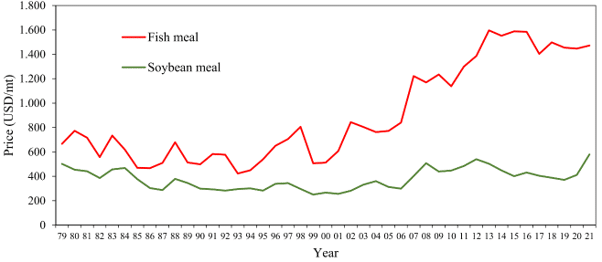
Figure 1. Annual prices of fishmeal and soybean meal between 1979 and 2021 (Nunes et al., 2022)
To support the development of aquaculture, it then became necessary to reduce the inclusion of these marine ingredients and replace them with alternative sources of proteins and fatty acids.
Numerous alternatives have been tested, including algae, insects, yeasts, and plants. Among these options, plant-based raw materials were selected due to their availability and low cost. However, the use of such plant ingredients presented several drawbacks, notably imbalances in essential amino acids (lysine and methionine), omega‑3 fatty acids, and minerals, as well as the presence of antinutritional factors.
65.4 to 14.5%
This is the decrease in the inclusion of fishmeal in salmon feed in Norway between 1990 and 2016.
Thanks to substantial research efforts, these limitations have been mitigated, allowing for a significant inclusion of plant-based materials in aquafeeds through adapted feed formulations. Nutrient imbalances were compensated by supplementing those present in lower quantities in plant ingredients compared to marine ingredients, such as certain essential amino acids or micro‑ingredients, including vitamins and minerals such as phosphorus. As a result, the inclusion of fishmeal in Atlantic salmon feeds in Norway decreased from 65.4% in 1990 to 14.5% in 2016, while the inclusion of plant protein sources increased from 0% to 40.3%.
In parallel with the increased use of plant-based raw materials, the inclusion of micro‑ingredients (vitamins and minerals) was quadrupled between 1990 and 2016 to compensate for mineral imbalances (Aas et al. 2022). A similar trend was observed for fish oil, which has been progressively replaced by vegetable oils (Figure 2).
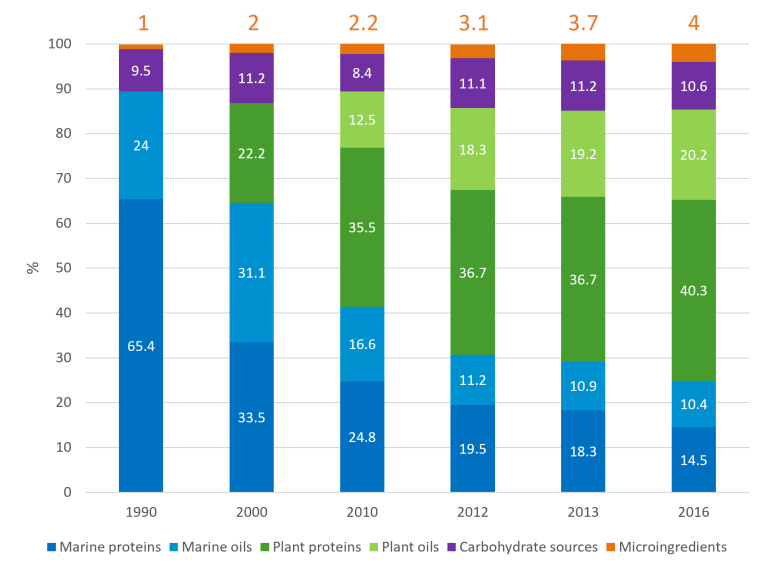
Figure 2. Evolution of Atlantic salmon feed formulations in Norway from 1990 to 2016 (Aas et al., 2022)
In shrimp feed formulations, the same trends are observed, with fishmeal decreasing from 28% in 1995 to 18% in 2007 (Tacon and Metian 2008).
Phosphorus in plant ingredients
While the replacement of fishmeal primarily affects the supply of proteins and essential amino acids, it also influences the intake of minerals, including phosphorus (P). Although plant‑based ingredients do contain phosphorus, it is mainly present in the form of phytic acid, which is poorly digestible for monogastric animals such as fish and shrimp due to their low endogenous phytase activity (Kumar et al. 2012).
Phytate
Main source of phosphorus in plant-based ingredients, very poorly digestible by fish and shrimps.
Consequently, replacing fishmeal with plant-based raw materials reduces the amount of digestible phosphorus available to aquatic species and may lead to P deficiencies, which can impair growth, induce skeletal deformities, reduce feed efficiency, and increase fat deposition (Sugiura et al. 2004).
As in other monogastric livestock species, supplementing diets with exogenous phytases can be considered to improve the bioavailability of phosphorus contained in plant ingredients. However, their effectiveness remains limited in aquaculture species. Several physiological factors specific to fish and shrimp hinder their enzymatic activity, including lower body temperatures, variable salinity, and generally higher intestinal pH. Since exogenous phytases exhibit optimal activity under acidic conditions, their efficiency is reduced in the digestive environment of fish and shrimp (Akpoilih et al. 2024).
To meet the phosphorus requirements of fish, animal by‑products such as poultry meals, bone meals, feather meals, or blood meals can be used. However, the digestibility of phosphorus in these ingredients is variable, and their quality can fluctuate, resulting in inconsistent digestible phosphorus supply. For a stable and reliable source of digestible phosphorus, it is preferable to use inorganic phosphates, which provide consistent levels of highly digestible phosphorus.
A need to supplement aquafeeds with inorganic phosphates
The stable phosphorus supply provided by inorganic phosphates helps improve aquaculture production by increasing bone mineralization (Hossain et al. 2020) and reducing the risk of skeletal deformities (Drábiková et al. 2021), stimulating non‑specific immunity in trout and shrimp (Hossain et al. 2020) (Phosphea unpublished data), reducing P discharge into the water (Morales et al. 2018), preserving water quality, and limiting environmental impact (Figure 3).
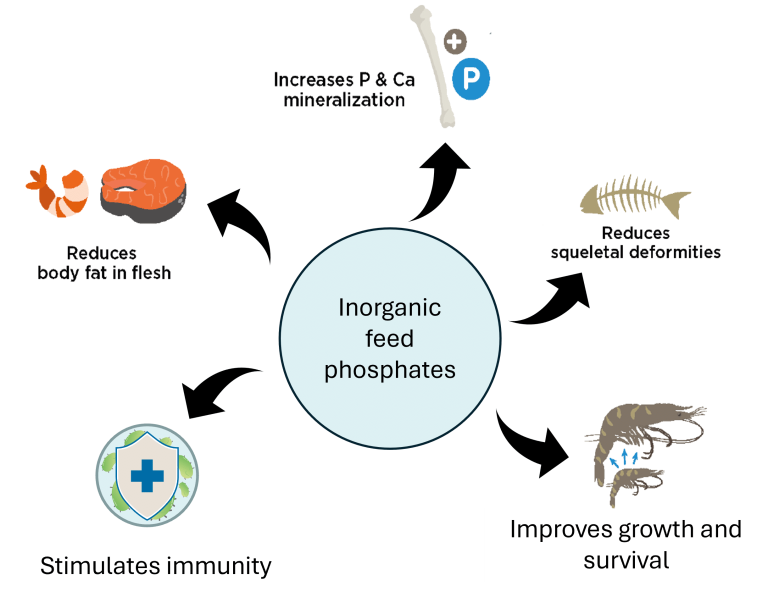
Figure 3. Benefits of inorganic phosphate supplementation in aquaculture species
Today, various inorganic phosphates are available on the market, each with different characteristics such as phosphorus content, water solubility of P, and calcium content. All these factors can influence phosphorus digestibility and therefore affect the efficiency of dietary phosphorus supplementation (Hua and Bureau 2010; Hossain and Yoshimatsu 2014; Morales et al. 2018; Hossain et al. 2020). As a result, phosphorus digestibility varies depending on both the phosphate source and the species considered.
Across aquaculture species, ammonium phosphate (MAP) and monosodium phosphate (MSP) are the most digestible inorganic phosphates, with average P digestibility values of 89.7% and 87.6%, respectively, according to our global analysis of phosphorus digestibility across inorganic phosphate sources in aquatic species (Figure 4).
87.6%
Average digestibility of P from MSP in aquaculture species.
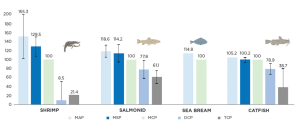
Figure 4. Digestibility of P according to inorganic feed phosphate and species (MCP, base 100)
(Lemos et al. 2021; Milián-Sorribes et al. 2021; Hossain et al. 2020; Morales et al. 2018; Pimentel-Rodrigues et Oliva-Teles 2007; Hua et Bureau 2010; Kaushik 2005; Nordrum et al. 1997; Satoh et al. 1997; Davis et Arnold 1994)
Calcium phosphates, which are more commonly used in the aquaculture industry, are less digestible, with an average P digestibility of 81.3% for monocalcium phosphate (MCP) and only 53.6% for dicalcium phosphate (DCP). DCP is therefore poorly digestible for most aquaculture species and is not recommended for their diets (Figure 4).
Higher phosphorus digestibility can significantly improve zootechnical performance, notably by reducing the feed conversion ratio (FCR), increasing the specific growth rate (SGR), and enhancing survival, as observed in whiteleg shrimp Litopenaeus vannamei.
+11% to +20%
This is the increase in shrimp biomass produced with MSP compared to MCP and DCP.
However, digestibility is not the only determining factor. Our recent study, conducted in 2024 in Indonesia on a wide range of inorganic phosphates, showed that even at equivalent levels of digestible phosphorus, the source of phosphorus strongly influences shrimp performance. The use of MSP and MAP resulted in faster growth and higher survival rates compared with other sources, particularly monocalcium phosphate (MCP). Production gains reached +11% compared with MCP and +20% compared with DCP (Figure 5).
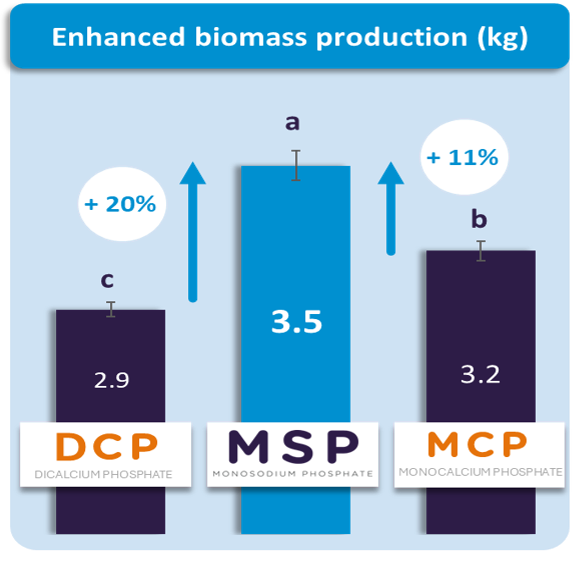
Figure 5. Effects of inorganic phosphates on shrimp production
(Phosphea data, 2024, under review)
Since the feeds compared contained similar levels of digestible P, these results suggest that phosphorus from MSP and MAP is more bioavailable to shrimp than P supplied by MCP. This hypothesis is consistent with a study conducted in trout, which reported higher vertebral P concentrations with MSP than with MCP or MAP, suggesting greater phosphorus bioavailability (Hossain et al. 2020).
Conclusion
With the reduction of fishmeal use in aquaculture feeds—and therefore the reduction in available dietary P—the inclusion of inorganic phosphates adapted to the needs of the target species and the farming system has become essential. It is crucial to prioritize highly digestible inorganic phosphates to ensure an efficient phosphorus supply for fish and shrimp. This not only helps optimize their performance but also limits the amount of supplemental phosphate required in the feed, thereby reducing P discharge into the water and the environment.
You may also like
Bibliography
Aas, Turid Synnøve, Torbjørn Åsgård, et Trine Ytrestøyl. 2022. « Utilization of feed resources in the production of rainbow trout (Oncorhynchus mykiss) in Norway in 2020 ». Aquaculture Reports 26 (octobre): 101317. https://doi.org/10.1016/j.aqrep.2022.101317.
Akpoilih, Benjamin U., Sylvanus A. Nwafili, et Ebere S. Erondu. 2024. « Microbial Phytases as Functional Feed Additives in Aquaculture: Impact, Challenges, Recent Developments and Future Opportunities ». In Sustainable Feed Ingredients and Additives for Aquaculture Farming: Perspectives from Africa and Asia, édité par Ndakalimwe Naftal Gabriel, Kenneth Prudence Abasubong, Victoria Ndinelago Erasmus, et Manoj Tukaram Kamble. Springer Nature. https://doi.org/10.1007/978-981-97-4279-0_23.
Davis, D. A., et C. R. Arnold. 1994. « Estimation of apparent phosphorus availability from inorganic phosphorus sources for Penaeus vannamei ». Aquaculture 127 (2): 245‑54. https://doi.org/10.1016/0044-8486(94)90430-8.
Drábiková, Lucia, Per Gunnar Fjelldal, Adelbert De Clercq, et al. 2021. « Vertebral column adaptations in juvenile Atlantic salmon Salmo salar, L. as a response to dietary phosphorus ». Aquaculture 541 (août): 736776. https://doi.org/10.1016/j.aquaculture.2021.736776.
Hossain, M. A., et T. Yoshimatsu. 2014. « Dietary Calcium Requirement in Fishes ». Aquaculture Nutrition 20 (1): 1‑11. https://doi.org/10.1111/anu.12135.
Hossain, Md. Sakhawat, Aksanti Barume Chance, Najlae El Kertaoui, et al. 2020. « Dietary Inorganic Monophosphates in High Plant Ingredient-Based Diets Influence Nutrient Digestibility, Postprandial Macro-Mineral Status and Immune Functions of Juvenile Rainbow Trout, Oncorhynchus Mykiss ». Aquaculture Nutrition 26 (6): 2178‑94. https://doi.org/10.1111/anu.13156.
Hua, K., et Dominique Bureau. 2010. « Quantification of differences in digestibility of phosphorus among cyprinids, cichlids, and salmonids through a mathematical modelling approach ». Aquaculture 308 (octobre): 152‑58. https://doi.org/10.1016/j.aquaculture.2010.07.040.
Kaushik, S. J. 2005. « Besoins et apport en phosphore chez les poissons ». INRAE Productions Animales 18 (3): 203‑8. https://doi.org/10.20870/productions-animales.2005.18.3.3525.
Kumar, V., A. K. Sinha, H. P. S. Makkar, G. De Boeck, et K. Becker. 2012. « Phytate and Phytase in Fish Nutrition ». Journal of Animal Physiology and Animal Nutrition 96 (3): 335‑64. https://doi.org/10.1111/j.1439-0396.2011.01169.x.
Lemos, Daniel, Rafael Coelho, Sjo Zwart, et Albert G. J. Tacon. 2021. « Performance and Digestibility of Inorganic Phosphates in Diets for Juvenile Shrimp (Litopenaeus Vannamei): Dicalcium Phosphate, Monocalcium Phosphate, and Monoammonium Phosphate ». Aquaculture International 29 (2): 681‑95. https://doi.org/10.1007/s10499-021-00651-3.
Milián-Sorribes, Maria Consolación, Ana Tomás-Vidal, David S. Peñaranda, et al. 2021. « Estimation of Phosphorus and Nitrogen Waste in Rainbow Trout (Oncorhynchus Mykiss, Walbaum, 1792) Diets Including Different Inorganic Phosphorus Sources ». Animals 11 (6). https://doi.org/10.3390/ani11061700.
Morales, Gabriel A., Rosendo L. Azcuy, Matías E. Casaretto, et al. 2018. « Effect of different inorganic phosphorus sources on growth performance, digestibility, retention efficiency and discharge of nutrients in rainbow trout (Oncorhynchus mykiss) ». Aquaculture 495 (octobre): 568‑74. https://doi.org/10.1016/j.aquaculture.2018.06.036.
Nordrum, Sigve, Torbjørn Åsgård, Karl D. Shearer, et Petter Arnessen. 1997. « Availability of phosphorus in fish bone meal and inorganic salts to Atlantic salmon (Salmo solar) as determined by retention ». Aquaculture 157 (1): 51‑61. https://doi.org/10.1016/S0044-8486(97)00145-2.
Pimentel-Rodrigues, A., et A. Oliva-Teles. 2007. « Phosphorus availability of inorganic phosphates and fish meals in European sea bass (Dicentrarchus labrax L.) juveniles ». Aquaculture, Nutrition and Feeding of Fish, vol. 267 (1): 300‑307. https://doi.org/10.1016/j.aquaculture.2007.01.018.
Satoh, Shuichi, Voranop Viyakarn, Toshio Takeuchi, et Takeshi Watanabe. 1997. « Availability of Phosphorus in Various Phosphates to Carp and Rainbow Trout Determined by a Simple Fractionation Method ». Fisheries science 63 (2): 297‑300. https://doi.org/10.2331/fishsci.63.297.
Sigler, J. W., et W. F. Sigler. 1986. « History of Fish Hatchery Development in the Great Basin States of Utah and Nevada ». The Great Basin Naturalist 46 (4): 583‑94.
Sugiura, S H, R W Hardy, et R J Roberts. 2004. « The Pathology of Phosphorus Deficiency in Fish – a Review ». Journal of Fish Diseases 27 (5): 255‑65. https://doi.org/10.1111/j.1365-2761.2004.00527.x.